
The Apple Shot and Its Aftermath
William TellThis flow traces the ordeal as a distinct sequence linking a public humiliation to imprisonment, escape, and Tell’s final decision.
increasing Bearing strength in each event
 decreasing
Bearing strength in each eventdecreasingThe Hat Refusal
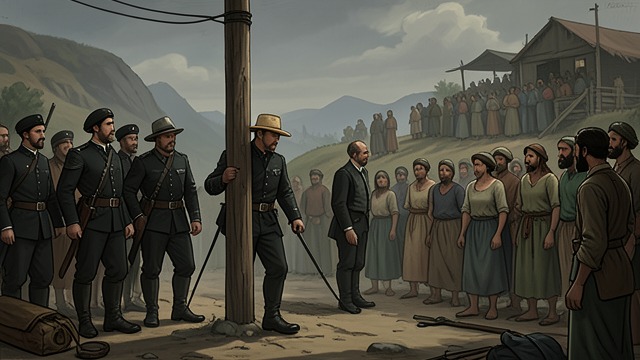
The Hat Refusal
A quiet act of noncompliance
Wilhelm Tell and Walter Tell pass Gessler’s hat without acknowledging it. Tell treats the pole as irrelevant, but the guards interpret his silence as defiance of the governor’s command.
An arbitrary offense
The soldiers accuse Tell of treason and try to seize him. His friends protest that he is an honest citizen, revealing how a petty order can become a pretext for political punishment.
The confrontation begins with a simple refusal but quickly exposes the imbalance of power. Gessler controls not only the public rule but also the meaning assigned to disobedience.
The Child Chosen as Target
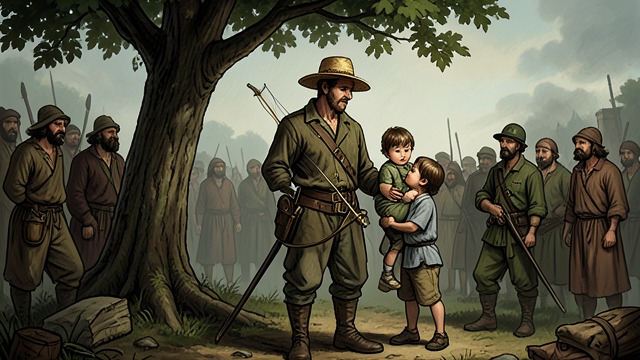
The Child Chosen as Target
A test of loyalty
Gessler asks whether Tell can shoot an apple at a distance and then orders him to place the skill against his own son. The challenge transforms a dispute over a salute into a spectacle of paternal terror.
Power over the family
Tell protests that no father should be asked to risk his child’s life. Gessler ignores him and orders Walter to stand beneath the tree.
The governor’s command is designed to show that private bonds offer no shelter from public authority. It makes the cost of refusal immediate and impossible to misunderstand.
The Shot and the Second Arrow
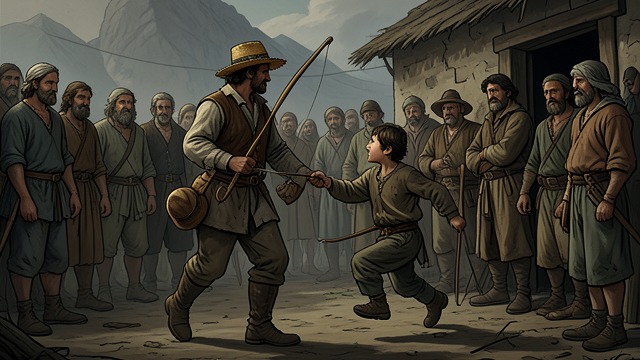
The Shot and the Second Arrow
A successful arrow
Tell regains control and strikes the apple while Walter remains unharmed. The crowd’s relief briefly eclipses the governor’s power, and the boy runs to his father.
An answer that changes the outcome
Gessler notices the second arrow and demands the truth. Tell says he would have aimed it at the governor if his son had died, turning his survival into an admission of resistance.
The accurate shot does not bring freedom. It instead gives Gessler a new reason to imprison Tell, illustrating how success under coercion may still carry consequences.
The Storm Opens a Way
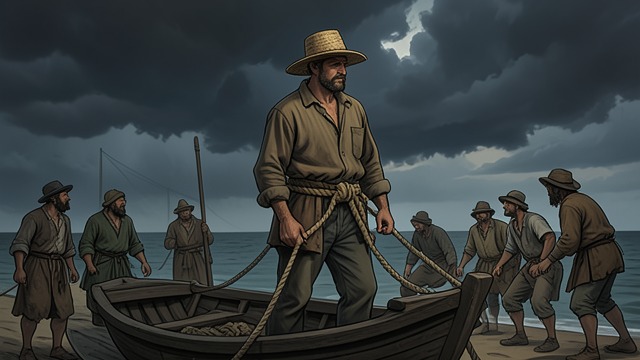
The Storm Opens a Way
A dangerous voyage
Gessler has Tell bound aboard a vessel headed toward Küssnacht. A violent storm overwhelms the sailors and threatens every person on board.
A captor’s dependence
The party releases Tell because he knows how to steer. He brings the vessel close to a rocky ledge, jumps ashore with his weapons, and escapes the governor’s immediate control.
The escape grows out of the contradiction in Gessler’s power: the governor can bind Tell, but in a crisis he must rely on the prisoner’s competence. Tell uses that dependence to regain his freedom.
The Arrow at Küssnacht
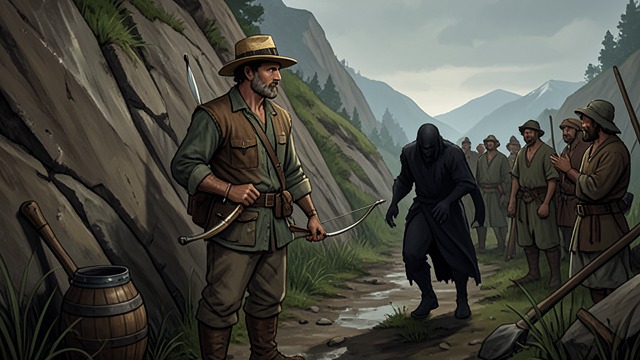
The Arrow at Küssnacht
A waiting archer
Tell anticipates Gessler’s route and hides beside the narrow pass. He remembers the apple ordeal and the vow made when he feared his son might die.
Violence and its stated purpose
When Gessler approaches, Tell shoots him. He identifies himself and declares that his household and the innocent are now beyond the governor’s reach.
The killing fulfills Tell’s promise but does not stand alone as the resolution of the political conflict. The remaining communities must act together to remove the governors’ wider system of rule.
Midway through the story, at Altdorf
Moments after Tell is brought before Gessler
At the climax of the apple ordeal
Soon after the ordeal, on Gessler’s ship
Near the ending, in the narrow pass
